
Online Chess Learning for Kids: What Every Parent Should Know
Chess has always been a game people associate with quiet clubs and over-the-board tension — but for most kids today, their first real chess instruction happens on a screen. Online chess learning for kids has grown from a niche option into one of the most common ways young players get started, and for good reason: it removes the two biggest barriers to good instruction, which are geography and scheduling.
At Summit School of Chess, we’ve spent the last 15 years teaching chess to kids across the Denver metro area, coaching 34 state champions along the way, and running both in-person and online programs side by side. That gives us a fairly unique vantage point on a question a lot of parents ask us: is online chess learning actually good for kids, or is it just a more convenient substitute for the real thing? Here’s an honest breakdown.
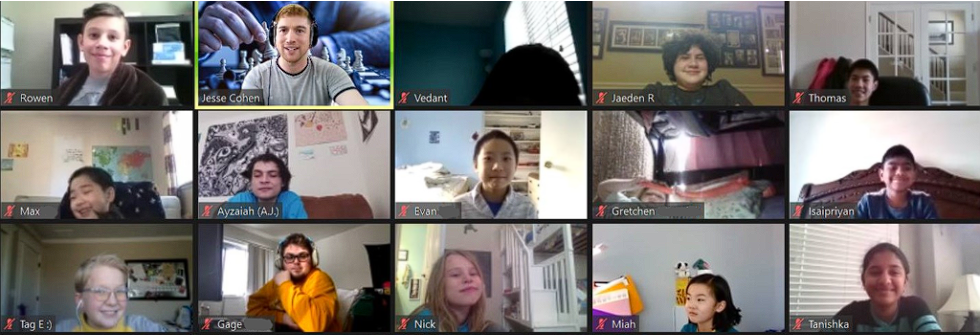
Pros and Cons of Online Chess Learning
The Pros
- No commute, no scheduling conflicts. A class that starts at 5 PM online doesn’t require anyone to sit in traffic first. That alone makes consistent, weekly instruction realistic for busy families.
- Access to better instruction than geography would otherwise allow. A family in a town with no local chess club can still get lessons from a titled coach.
- Built-in tools that speed up learning. Interactive boards, instant move feedback, and puzzle libraries let kids drill tactics in a way a physical board can’t easily replicate.
- Lower pressure for beginners. Some kids who freeze up across a physical board from an adult loosen up on a screen, which can make the first few lessons less intimidating.
- More affordable at scale. Group online classes are typically priced well below one-on-one in-person tutoring, which matters for families wanting weekly instruction rather than an occasional lesson.
The Cons
- It takes real self-discipline. A 7-year-old alone in front of a screen is more likely to get distracted than one sitting across a board from a coach.
- Less physical board sense. Kids who only ever play online can be slower to learn notation, the touch-move rule, and other over-the-board conventions they’ll need for in-person tournaments.
- Technical friction. Spotty Wi-Fi or an unfamiliar video platform can eat into lesson time, especially with younger kids.
- Reduced social element. Some of what makes chess valuable for kids — reading an opponent, handling a loss in the room with them, the camaraderie of a chess club — comes through less strongly on a screen.
- Requires more parental involvement for younger kids, at least until they can manage login links and class etiquette independently.
Comparative Analysis of Online vs. In-Person Lessons
The honest answer is that neither format is strictly better — they’re suited to different kids and different goals.
Cost and access clearly favor online. A family anywhere in the Denver metro area, or well outside it, can get the same instruction as a family five minutes from a coach’s office. Structure and discipline tend to favor in-person, especially for kids under 8, who generally focus better with an adult physically present. Skill development is close to a wash for most of what matters early on (openings, tactics, basic strategy) — but in-person play still has an edge for tournament readiness, since kids need to handle a physical clock, notation sheet, and opponent to compete in USCF-rated events like the ones we run monthly at the Jefferson County Fairgrounds in Golden.
In practice, the strongest approach we see is a hybrid: weekly online lessons to build the foundation efficiently, paired with periodic in-person practice — a camp, a club session, or a rated tournament — to translate that knowledge to the physical board. Kids who do both tend to progress faster than kids who do either exclusively.
Key Considerations for Parents
If you’re deciding whether online chess learning is right for your child, a few things matter more than others:
- Age and attention span. Kids in kindergarten through roughly 2nd grade usually do better with either a parent nearby during class or a shorter, more game-based format. Older elementary kids and up generally handle a full hour independently.
- Who’s actually teaching. “Online chess coach” isn’t a credential. Look for a titled player (National Master, FIDE Master, etc.) with a track record of results, not just enthusiasm.
- Class size and format. Live, small-group instruction with real-time feedback beats a pre-recorded video course for kids who are still building fundamentals.
- A way to test the waters. A trial lesson or money-back guarantee tells you a lot about a program’s confidence in its own teaching.
- A path to in-person play eventually. Even if you start online, look for a program that also offers camps, tournaments, or a school program, so your child isn’t stuck without a bridge to over-the-board chess.
- Screen time in context. An hour of focused, coach-led chess instruction is a very different use of screen time than passive entertainment — but it’s still worth weighing against your family’s overall screen-time picture.
Success Stories and Expert Insights
The research on chess and kids is genuinely strong, not just marketing language. One of the most cited studies, a five-year look at 7th and 8th graders in the Bradford, PA school district, found test scores improved 173% for students regularly engaged in chess classes, compared with only 4.56% for children in other enrichment activities. More recent analysis of scholastic players has found the gains scale with how seriously a kid plays: casual chess-club participation nudges math scores up modestly, while kids who play in rated tournaments see substantially larger gains — 30 to 50% in math and 10 to 20% in reading. chesshousesagepub
The online chess boom itself is well documented too. When The Queen’s Gambit premiered alongside pandemic-era lockdowns, chess app downloads rose 63%, Chess.com registrations more than doubled in a single month, and monthly games on Lichess doubled as well — proof that online platforms can absorb huge new interest without losing quality of instruction, when paired with real coaching. chess
On our end, that’s borne out directly: our coaching staff, led by National Master and Colorado State Chess Association Vice President Jesse Cohen, has coached 34 state championship titles and introduced thousands of kids across the Denver metro area to the game — a mix of students who started in our online classes, our school programs, or both.
How Summit School of Chess Can Help
Whichever path fits your child best, Summit has a way in. Our Online Group Lessons run daily for players of every skill level, taught live by our coaching team — a great starting point if online is the right fit for your family right now. When it’s time to bring that learning to a physical board, our Summer Chess Camps are a great next step for kids who want to build skills hands-on, and our Monthly Chess Tournaments give both online and in-person students a low-stakes way to test what they’ve learned.
If your child’s school doesn’t yet have a chess program, you can also get a School Chess Program started there. And for kids who want to keep playing between lessons, our official Summit School of Chess Club on Chess.com is open to join. You can also follow along with camp updates, tournament results, and program news on Facebook and Twitter (X).
The Bottom Line
Online chess learning for kids isn’t a lesser version of in-person instruction — it’s a genuinely good starting point for most families, especially when it’s paired with real opportunities to play over the board. The kids who benefit most aren’t the ones who pick one format and stick with it forever; they’re the ones who use online lessons to build the foundation, then bring that knowledge to a camp, a club, or a tournament to make it stick.