
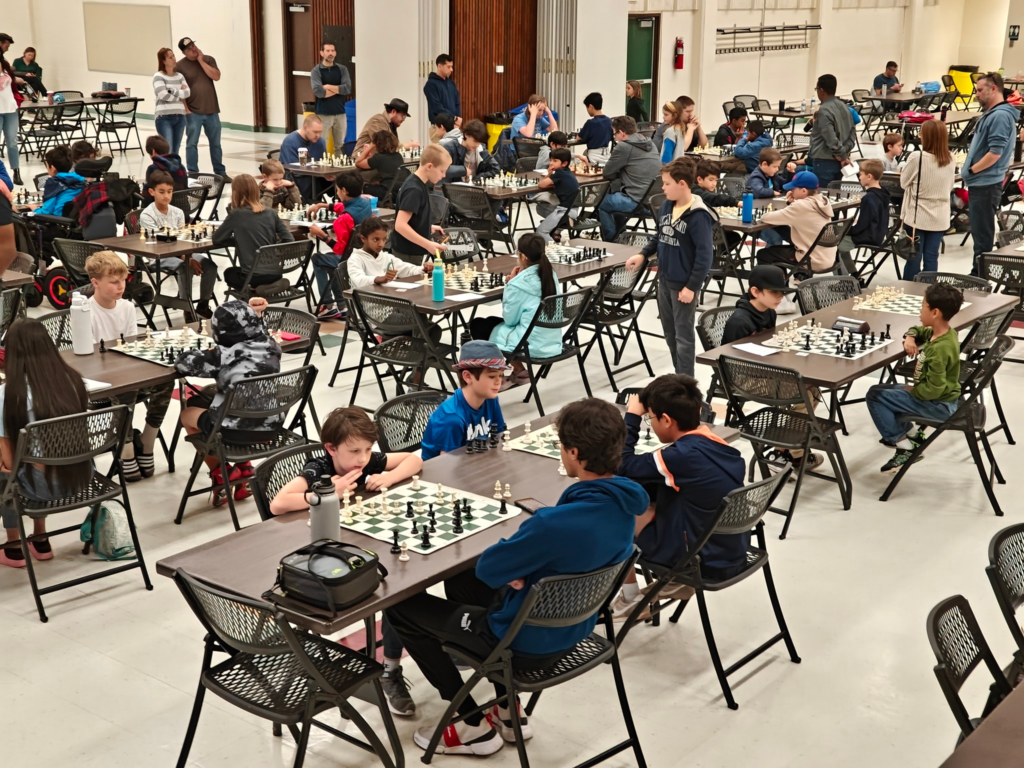
If you’re a Denver Parent, your kid has been playing chess at school for a few months. They’ve started beating you. Their coach mentioned a tournament, and now you’re looking at a registration page wondering whether this is a wonderful idea or a Saturday you’ll spend consoling a crying eight-year-old in a parking lot.
I’ve directed and coached at youth tournaments across Colorado for fifteen years. Here’s what actually happens, what parents get wrong, and how to make the first one go well.
Is my child ready?
Earlier than most parents assume. A child is ready for their first tournament when they can do three things:
- Move every piece legally, including castling and en passant
- Finish a game without wandering off
- Sit still for roughly thirty minutes
That’s it. They do not need to know openings. They do not need to have won anything. They do not need to be “good.” The first tournament is not a test they pass or fail — it’s the thing that turns a kid who knows chess into a kid who plays chess, and the difference between those two is enormous.
The most common mistake I see is a parent waiting until their child is ready to win. Kids who wait get more nervous, not less.
Rated, unrated, and which one to pick
Two kinds of events show up on Colorado calendars.
Unrated (or novice) sections are the on-ramp. No national membership required, shorter games, a friendlier room. If your child has never played a serious game against a stranger, start here.
Rated sections are run under US Chess rules, and results go into a national rating — a number that tracks improvement over a career. Playing rated requires a US Chess membership, which you can buy online before the event or at the door.
The rating is the part that hooks kids, for better and worse. It gives them something objective to chase, and it makes improvement visible in a way that a coach saying “you’re getting better” never quite does. It also means a bad day follows them home as a number. Most kids handle this far better than their parents do.
Our monthly events in Golden run both rated and unrated sections, so a family with two kids at different stages can do one trip.
How a Saturday actually runs
Here’s the thing almost every new chess parent gets wrong: it is not an elimination bracket. Your child does not lose and go home.
Youth tournaments use a Swiss system. Everyone plays every round. After each game, the software pairs your child against someone with a similar score — win and you face a tougher opponent, lose and you face someone closer to your level. A kid who loses the first game still plays all the remaining rounds, and usually wins one or two of them.
A typical day looks like this:
- Check-in, then pairings go up on a wall or a screen. Find your child’s name, board number, and color.
- Round 1. Parents leave the playing room. Games take anywhere from ten minutes to an hour.
- Between rounds, kids spill into the skittles room — the informal area where they replay their games, eat, and make friends. This is genuinely half the value of the day.
- Rounds 2 through End, same rhythm.
- Awards. Trophies or medals for top finishers, and at most scholastic events, something for everyone in the youngest sections.
Plan on the whole thing taking Don’t schedule anything else that day.
What to bring
The organizer supplies boards, pieces, and clocks — you don’t need to buy equipment for a first event.
Bring: water, a book or something quiet for downtime, a jacket, and a pen if your child is old enough to record moves. Leave the tablet in the car if you can; kids who bury themselves in a screen between rounds don’t make friends, and the friends are the reason they come back.
What parents do during the day
Not much, and that’s the point.
You can’t watch the games. You can’t help. Coaching a player mid-game — even a gesture — gets a child forfeited, and at a kids’ tournament the offender is almost always a well-meaning parent.
What you can do matters more than it sounds:
- Get there early enough that your child isn’t rushing
- Meet them at the door after each game with a neutral face
- Ask “how did it go?” not “did you win?”
- Let them tell you about the game before you say anything about it
The kids who last in this game are the ones whose parents were the same person after a loss as after a win.
The first loss
Your child will probably lose two of their games. That is not a bad tournament — that’s the pairing system doing exactly what it’s built to do. A perfectly average first event is two wins, two losses, and one kid who is quietly proud of the two wins.
Some kids cry. Roughly a third of first-timers do, in my experience, and none of them remember it a year later. What they remember is that they went, that they played real games against real opponents, and that their parents seemed glad they did it.
If your child wants to quit after the first round, let them finish the day if they can — the last round of the first tournament is where a lot of kids fall in love with this. If they truly can’t, take them home without a lecture and ask again in a month.
Where kids play chess tournaments in the Denver metro
Colorado has a healthy youth chess scene, and it’s not hard to find games once you know where to look.
Monthly tournaments in Golden. Summit School of Chess runs monthly US Chess-rated and unrated tournaments at the Jefferson County Fairgrounds in Golden — central enough to be a reasonable drive from Arvada, Westminster, Lakewood, Boulder, Littleton, and the north metro. These are built as an entry point: a parent from Thornton or Longmont can bring a kid who’s never competed and find a section that fits.
School chess clubs. Many Denver-area elementary and middle schools run before- or after-school chess programs, including 40–50 schools where our coaches teach each year across the metro — Adams 12, St. Vrain Valley, Boulder Valley, Jeffco, Denver Public Schools, and others. A school club is the lowest-friction way to start, because the tournament conversation begins with a coach your child already trusts.
State scholastic championships. Colorado’s state chess affiliate runs annual scholastic championships by grade level . These are bigger and louder than a monthly event — worth attending after two or three smaller tournaments, not as a first one.
Libraries and rec centers. Several metro libraries and recreation centers host casual chess sessions. No ratings, no pressure, good practice.
Frequently asked questions
How old should a child be to play in a chess tournament? Most kids are ready between ages 6 and 8, though the real test is behavioral, not chronological: can they play a full game and sit still for about thirty minutes? Plenty of five-year-olds can, and plenty of nine-year-olds aren’t there yet.
Does my child need a US Chess membership? Only for rated sections. Unrated and novice sections don’t require one. Memberships can be purchased online in advance or at the tournament.
How long does a youth chess tournament last? Most single-day scholastic events run [CONFIRM] hours including breaks and awards. Plan for the full day rather than trying to fit it around another activity.
What if my child loses every game? It happens, and it’s survivable. The Swiss pairing system will match them with progressively easier opponents as the day goes on, so the last rounds are usually competitive. Nearly every strong player in Colorado lost badly at their first event.
Do I need to buy a chess set, board, or clock? No. Equipment is provided at the tournament. If your child sticks with it, a tournament set and clock are worth buying later — but not for the first event.
Where can my child play chess tournaments near Denver? Summit School of Chess hosts monthly rated and unrated tournaments at the Jefferson County Fairgrounds in Golden, and school-based chess clubs run throughout the metro during the school year.
Getting started
We’ve been teaching chess in the Denver metro for fifteen years — before- and after-school programs in 40–50 schools each year, private lessons, online group classes, summer camps, and monthly tournaments in Golden. In that time our students have won 34 Colorado state championship titles, and considerably more of them have simply become kids who love the game.
If you want help figuring out whether your child is ready — or which section to enter — call or email. We answer these questions all year.
Summit School of Chess Westminster, CO · serving the Greater Denver Area (720) 243-1450 · jessercohen@summitschoolofchess.com summitschoolofchess.com
Jesse Cohen is a US Chess National Master and the founder of Summit School of Chess.
Our Summer Chess Camps are the best!
We have daily Online Group Lessons for all players of all skill levels!
Our Monthly Chess Tournaments are great for testing your skills!
Get a School Chess Program today!
Join the official Summit School of Chess Club (on Chess.com)